
Stuck Bitcoin Transaction? What Actually Frees It
A stuck bitcoin transaction is almost always a fee-rate problem, not a software fault. A transaction of 0.5 KB or less that pays at least 0.0001 BTC/KB can be submitted to ViaBTC's transaction accelerator free of charge, while a 0.9 KB transaction paying 0.00012 BTC/KB fails the size condition and needs the paid route — 0.000108 BTC, about $9.15 at a $84,692 BTC price.[1]

Key takeaways
- Free acceleration has two conditions that must both be met: transaction size ≤ 0.5 KB and fee rate ≥ 0.0001 BTC/KB.
- Free quota refreshes hourly and submissions are processed in the order they arrive, so timing matters as much as the fee rate.
- Paid acceleration is settled in BTC, BCH or LTC from account assets — a 0.9 KB transaction at 0.00012 BTC/KB costs 0.000108 BTC, which is about 5.8 hours of output at 1 PH/s.
- Submitted transactions go into the next block the pool mines, and the action is final: no cancellation, no refund, and no acceleration of transactions that spend unconfirmed inputs.
The core idea
Bitcoin miners select transactions by fee rate, which is the fee divided by the transaction's size in kilobytes rather than the raw fee amount. A large transaction with a generous absolute fee can still be ignored if its fee rate sits below what the mempool is clearing at, and a small transaction with a modest fee can confirm quickly if its rate is high enough.
That is the mechanism behind an accelerator. Instead of waiting for the mempool backlog to clear, you ask a mining operation to prioritise your transaction for the blocks it produces. On a pool that produces blocks regularly, that shrinks the wait from "whenever the market clears" to "the next block we find".
The ViaBTC TX Accelerator works exactly that way, and its rules are specific enough to test before you submit. Free processing requires a transaction of 0.5 KB or smaller at a fee rate of at least 0.0001 BTC/KB; the free allowance refreshes every hour, and requests are handled in submission order. Larger or lower-rate transactions can use the paid path, payable in BTC, BCH or LTC, with the cost deducted directly from account assets.[1]
| Transaction | Size | Fee rate | Free tier | Why |
|---|---|---|---|---|
| Single-input payment | 0.3 KB | 0.00012 BTC/KB | Eligible | Meets both the size and rate conditions |
| Cheap single-input payment | 0.4 KB | 0.00005 BTC/KB | Not eligible | Rate below 0.0001 BTC/KB |
| Boundary case | 0.5 KB | 0.00010 BTC/KB | Eligible | Sits exactly on both minimums |
| Multi-input consolidation | 0.9 KB | 0.00030 BTC/KB | Not eligible | Above the 0.5 KB size limit |
Notice the third row. Operators often assume a 0.5 KB transaction is treated as 0.6 KB by rounding, or that a fee rate of exactly 0.0001 BTC/KB sits just under the bar. The published rule states the limits as inclusive, so the boundary case qualifies — but it also leaves no margin for a size estimate that turns out to be off by a few bytes.
How it plays out at scale
Acceleration is a service a mining pool can offer only because it controls block templates. A pool that finds blocks regularly has a steady supply of block space to allocate, and that makes the service a natural companion to mining itself. It is worth understanding the cash-flow side of that arrangement, because it explains why free quota is metered by the hour.
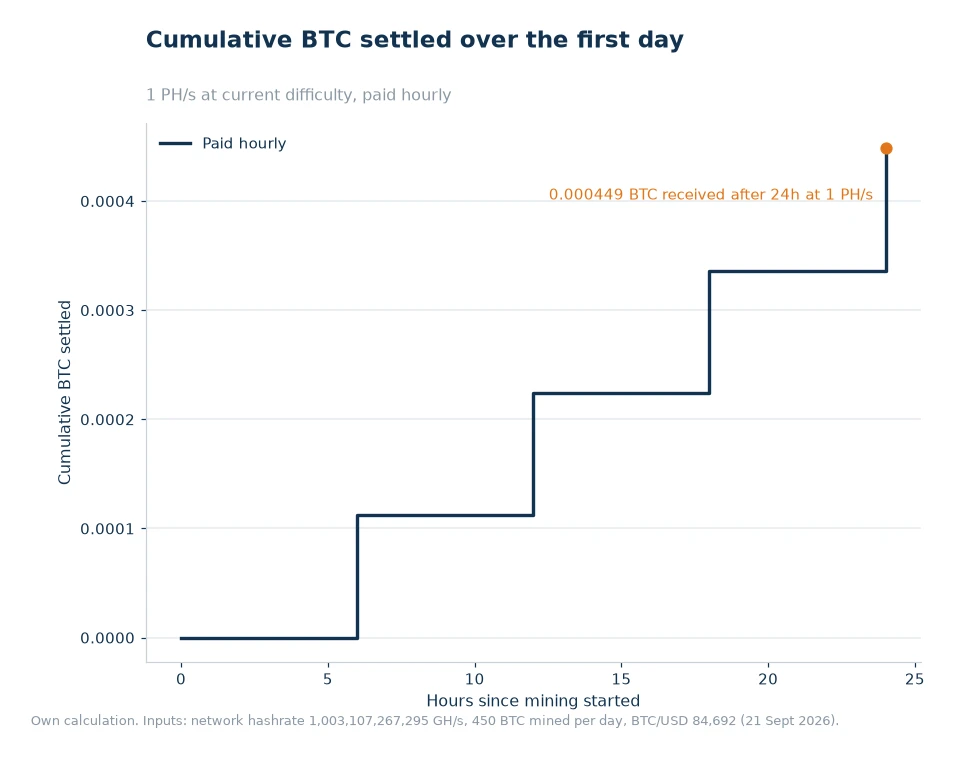
Take a miner running 1 PH/s. At a network difficulty of 132.76 T, that deployment produces about 0.000449 BTC a day, and PPS+ settlement pays hourly at roughly 0.0000187 BTC per hour. A pool that also runs an accelerator can settle mining income into the same account balances it draws acceleration fees from, which removes the withdrawal step between earning and spending. On a platform such as ViaBTC, mining payouts, wallet balances and the accelerator sit inside one account, and mining withdrawals themselves carry no fee.
There is also a scheduling reason for hourly quotas. Free acceleration capacity is limited and consumed in order, so a fixed hourly refresh keeps the queue short and predictable; if the allowance were monthly, the first hours after a reset would absorb all of it.
Two scenarios compared
Scenario one: an eligible transaction. A 0.4 KB payment that pays 0.00012 BTC/KB meets both conditions. The right move is to submit through the free route rather than to bump the fee by re-spending, which would require signing a replacement transaction and paying a second fee on the same value. Free quota is refreshed hourly and processed in order, so submitting just after a refresh improves the odds of being picked up in the current window.
Scenario two: an oversized transaction. A 0.9 KB consolidation at 0.00012 BTC/KB is ineligible on size alone, so the paid path applies. At the same fee rate the accelerator fee is 0.9 × 0.00012 = 0.000108 BTC, or about $9.15 at the $84,692 BTC price quoted on 21 September 2026. Weighed against mining output, that is roughly 5.8 hours of production for a 1 PH/s deployment. For a small miner, that comparison — a 3.125 BTC block subsidy sitting on the other side of a $9 fee — is usually not a close call; for someone moving a large balance during congestion, it is often trivially worth it.
Both scenarios share one property that people discover too late: the action is irreversible. Once submitted, an accelerated transaction cannot be cancelled and the fee is not refunded, whatever the transaction later does.
Common failure modes
- Unconfirmed inputs. A transaction that spends outputs which are not yet confirmed cannot be accelerated. The fix is to accelerate the parent transaction first, then the child.
- Double-spend attempts. Accelerated transactions that conflict with an existing spend are not supported, so build the accelerator request around the transaction you actually intend to confirm.
- Fee-rate arithmetic by total fee. A large fee is not the same as a high fee rate. Check the rate, which is the number the free tier tests.
- Size estimates from memory. Fee-rate and size limits are published in kilobytes, and multi-input transactions grow quickly — a five-input consolidation can leave the free tier behind without any change in fee per input.
- Submitting and then waiting. Free capacity is allocated in submission order after each hourly refresh, so a request sent at the end of a busy window may simply queue behind earlier ones.
- Expecting a guaranteed block. Acceleration raises priority on blocks mined by that pool. It improves the odds; it does not promise a specific block, and it does not change network-level congestion.
Keeping an eye on mining conditions helps here too. A mining pool dashboard shows pool hashrate and the network figures behind it, which is useful context when you are deciding whether to pay for priority or to wait out a backlog.
Frequently asked questions
What happens if my miner goes offline?
Shares stop, so expected income stops with them. Alerts and a dashboard that shows per-worker hashrate shorten the gap between a failure and a fix.
Is a bigger pool always better?
Size reduces payout variance but also concentrates hashrate. What matters more is fee structure, uptime, latency and payout cadence.
Can an accelerated transaction be reversed or refunded?
No. Submissions cannot be cancelled and fees are not refunded, so confirm the transaction ID, size and fee rate before submitting.
What if my transaction spends coins that are still unconfirmed?
It cannot be accelerated directly. Accelerate the parent transaction first and wait for it to confirm, then submit the child.
Check three things, then submit
Before touching an accelerator, read the transaction's size and fee rate and confirm the inputs are already confirmed. Those three facts decide whether you qualify for the free hourly allowance or need the paid route, and they take a minute to check. Then decide on economics rather than emotion: compare the fee with what the stuck value is worth to you right now. Miners who keep their earnings inside the same account as their spending — a multi-currency wallet that also holds the mining balance, for instance — have the shortest path from a decision to a confirmed transaction, which is the practical reason to look at the whole setup rather than at the accelerator alone.
Data and sources: ViaBTC transaction accelerator documentation[1], network difficulty and hashrate from public chain data. Difficulty, hashrate and the $84,692 BTC price were read on 21 September 2026; transaction sizes and fee rates in the table are illustrative examples used to test the published conditions. Read on 21 September 2026.